
AI Agents for Tradies: The Real Cost of Missed Calls (And What Fixes It)

Why This Actually Matters
You're under a house, hands full of PVC glue, and your phone buzzes in your pocket. By the time you climb out, wipe your hands, and call back, the person's already booked someone else. That's not a hypothetical. It's Tuesday. And if the average trade job is worth around $850, a single missed call isn't a minor inconvenience. It's potentially $850 walking straight to a competitor who happened to pick up.
Multiply that by two or three missed calls a day, five days a week, and you're looking at $8,000–$12,000 a month in work that never even made it to your quote book. That's the gap AI agents for tradies are actually built to close: not to make you look "high-tech," but to stop bleeding revenue you never see because it never shows up as a lost job. It just shows up as a quiet month.
What an AI Agent For Tradies Actually Is
Strip away the buzzwords and it's simple: an AI agent is software that answers your phone, texts, or website chat when you can't, using a voice or chat model trained on how your business actually operates: your services, your suburbs, your pricing rules, your availability.
It's not a call centre. It's not an answering machine that says "leave a message." It listens, asks the right follow-up questions ("Is this urgent? Is water actively leaking?"), books the job straight into your calendar or job management software (Tradify, ServiceM8, SimPRO), and texts you a summary before you've even finished the task you were doing.
We didn't get to that point overnight. As a business that builds and runs one of these platforms for tradies, we spent close to eight months testing and iterating across different AI voice technologies before landing on the one we now build on. Most off-the-shelf voice models at the time sounded exactly like what you'd expect: stilted timing, awkward pauses, and no idea what to do with tradie-specific terms like "callout fee" or "progressive payment." Getting an agent to sound like it belonged on a tradie's phone line, rather than a generic call centre script, took far longer than we expected going in.
If you're starting from zero, think of it in three layers:
- Capture: answers the call/text/web enquiry instantly, 24/7
- Qualify: asks scoping questions so you're not calling back a tyre-kicker
- Convert: books the job, takes a deposit if needed, sends confirmation
Most tools on the market (whether it's a broad platform or something built specifically for trades, like Tradie Hub or Tradie Bot) are really just different combinations of those three layers with different levels of polish.
The Real Cost of a Missed Call, Worked Out Properly
Here's the calculation most sales pages skip because it makes the case for them without needing a demo.
Say you get 15 inbound enquiry calls a week. Industry call-tracking data from trade businesses consistently shows 20–35% of calls go unanswered during work hours, not because tradies are lazy but because you're physically on tools, driving, or underneath something. Take the conservative end: 20%, or 3 calls a week.
- 3 missed calls x 52 weeks = 156 missed calls a year
- Even if only half convert to paying jobs, that's 78 jobs
- At $850 average job value, that's $66,300 a year left on the table
That number is why AI phone agents for tradies have gone from a novelty to something plumbers, sparkies, and builders are actively comparing month to month. It's not about efficiency for its own sake. It's about a leak in the business that's invisible until you actually track it. It also lines up with what we see from the other side of the fence: clients running our AI phone system consistently report savings in the range of $2,000–$3,000 a month in jobs that would otherwise have gone to voicemail, which sits comfortably inside the maths above.
How It Works On an Actual Job Site
Here's what a real day looks like once one of these is running properly, based on how trade businesses commonly report using them:
A homeowner calls at 10:40am about a hot water system that's stopped working. The AI agent answers within two rings, confirms the suburb is in your service area, asks if it's a gas or electric unit, and whether there's any visible leaking. It quotes your standard callout fee, checks your calendar, and offers the next available slot: 2pm or tomorrow 8am. The customer picks 2pm. You get a text: "Booked: Sarah, 14 Gum St, hot water system not heating, electric, no leak, $150 callout, 2pm today." No missed context, no game of phone tag.
Compare that to the old version: voicemail, customer hangs up, calls the next number on Google.
What The Sales Pages Leave Out
This is the part almost nobody explains clearly, and it's why so many tradies try one tool, get frustrated, and assume "AI doesn't work for trades."
- Setup isn't instant. Expect 3–10 days to properly train the agent on your pricing, service radius, and common job types. Tools that promise "5-minute setup" usually mean a generic script, not one that actually sounds like your business. That 3–10 day window is short precisely because of the work already done on the backend. As the team behind the tech, we spent the better part of eight months testing voice models before landing on one that didn't make people ask "am I talking to a robot?" on every second call.
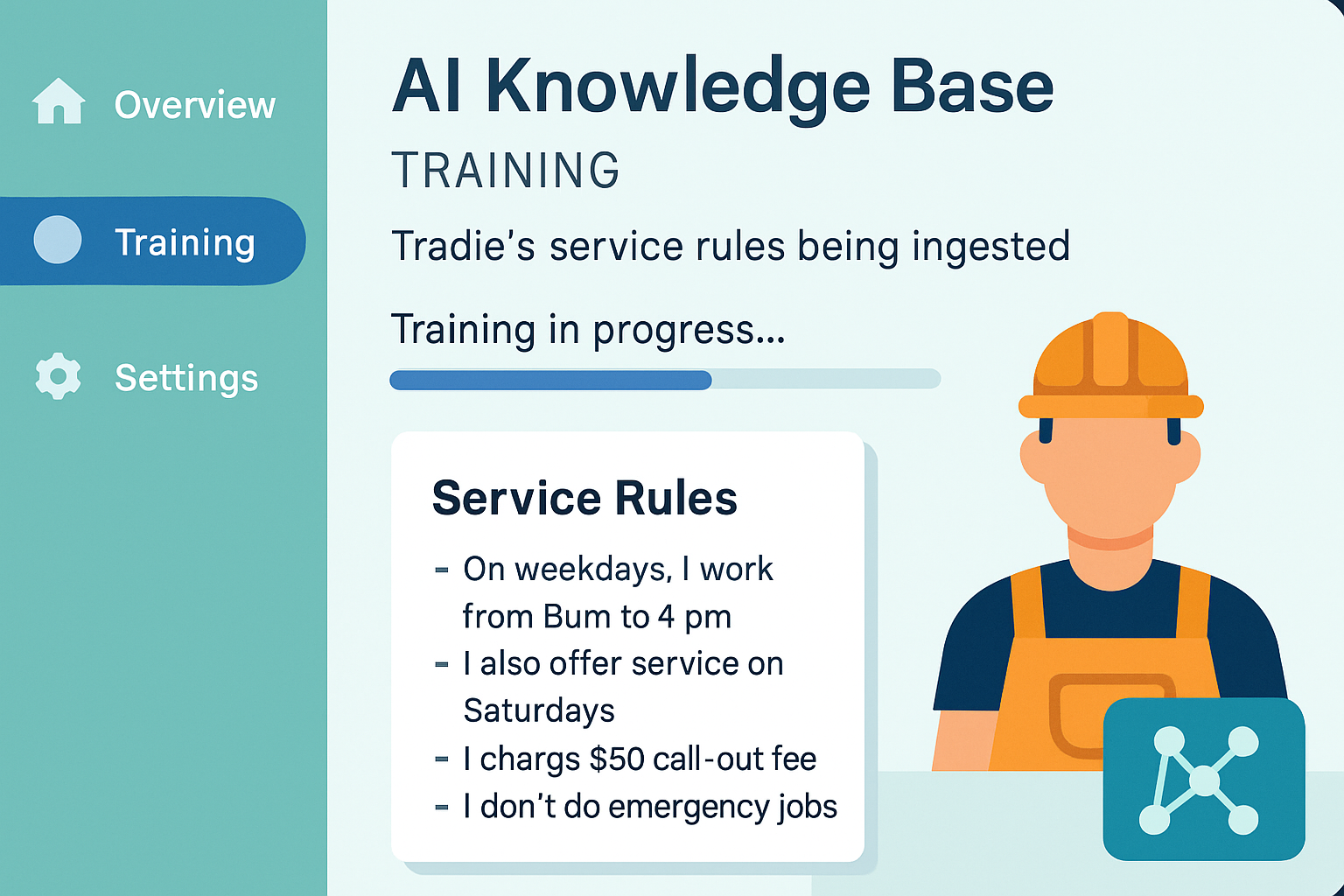
- It won't handle everything, and it will get things wrong before it gets them right. Complex insurance jobs, disputes, or anything requiring judgment still needs you or your office admin. We learned this one the hard way early on: our first version of the agent didn't have a site crawler pulling live details from a tradie's own website, and it didn't have a custom knowledge base trained on that specific business's operating procedures. The result was an agent that occasionally quoted a flat callout fee for a job type the business didn't actually do, or gave a service-area answer that was technically correct company-wide but wrong for that particular tradie. The fix wasn't more scripting. It was building a proper crawler and a knowledge base trained on the business's actual documents and procedures. Once that was in place, wrong answers dropped off sharply.
- Voice still sounds slightly off to some callers. It's improved a lot in the last 12–18 months, but a small percentage of older or wary customers will ask "am I talking to a robot?" Being upfront ("I'm an assistant booking jobs for [business name]") builds more trust than pretending otherwise.
- Integration is the real make-or-break. If it doesn't talk to your existing job management software, you've just created a second inbox to check, which defeats the point entirely. This is exactly why we built our platform as our own end-to-end SaaS rather than bolting a voice layer onto someone else's tool: it meant we controlled the integration instead of hoping a third-party API held up.
- Ongoing cost is monthly, not one-off. Most sit between $150–$500/month depending on call volume, which needs to be weighed against the missed-call math above, not against "free."
Tradie Hub, Tradie Bot, and the Rest: How to Actually Compare Them
There's no shortage of platforms marketing specifically to trades right now, and the space has moved fast enough that a lot of comparison articles from even a year ago are already out of date on pricing and features. Rather than chasing brand names, compare on these four things:
- Does it integrate with your job management software directly, or does someone need to manually re-enter bookings?
- Can you hear a sample call before signing up? If a provider won't let you test the voice quality on a real scenario from your trade, that's a red flag.
- What happens after hours? Some tools only run business hours by default, so check this explicitly, since after-hours enquiries are often your highest-value ones (emergencies pay more).
- Who owns the data and call recordings? You want the ability to export lead information if you switch providers later.
Full disclosure: we're on the building side of this, not just the buying side: we develop and run an AI agent platform for tradies ourselves. That's exactly why we'd point you to this checklist rather than a features list. These are the questions tradies actually ask us before signing up, and the ones we wish more providers in this space got asked more often.
Whether you're looking at Tradie Hub, Tradie Bot, or a general-purpose AI receptionist tool, run the same checklist. The category matters less than the fit.
A Realistic First 30 Days
One electrical contractor running a two-van operation started using an AI phone agent purely to cover lunch breaks and job-site hours. In the first 30 days, the agent handled 61 calls that would have previously gone to voicemail. Of those, 22 converted to booked jobs. At an average job value of roughly $780 for that business, that's over $17,000 in work captured in a single month that historically would have been missed or delayed enough for the customer to call someone else.
Not every result will look like that, since call volume and job value vary a lot by trade, but it illustrates the order of magnitude worth testing for, and it tracks with the recurring feedback we hear from our own client base: most land somewhere in the $2,000–$3,000 a month range in recovered work once the agent is properly trained on their business.
Mistakes That Kill Adoption
- Turning it on and never reviewing call transcripts in the first two weeks. Small scripting errors compound fast
- Not telling regular customers it exists, so they assume it's a generic call centre and hang up
- Setting pricing rules too rigidly, so it quotes jobs that need an on-site assessment
- Skipping the knowledge base and crawler setup because it feels like an extra step. This is the single biggest source of wrong answers we've seen, and it's avoidable
- Expecting it to replace your office admin entirely instead of freeing them up for higher-value work
Getting Started This Week
If you're time-poor and just want a next step: track your missed calls for five business days using your phone's call log, multiply by your average job value, and use that number, not a sales pitch, to decide whether this is worth trialling. Most providers offer a 7–14 day trial. Test it on your after-hours line first, since that's the lowest-risk, highest-upside starting point, then expand once you've heard how it handles three or four real calls.